
If you own a property in Spain but live abroad, paying your annual IBI (council tax) is only half of what the Spanish tax authority expects from you. Most non-resident owners also owe a second, separate tax filed on Modelo 210, and many UK and Irish owners on the Costa Cálida do not realise it exists until a penalty letter arrives. This guide explains what Modelo 210 is, the surprising “imputed income” tax you owe even on an empty holiday home, the 2026 rates and deadlines, and how to stay compliant.
What is Modelo 210?
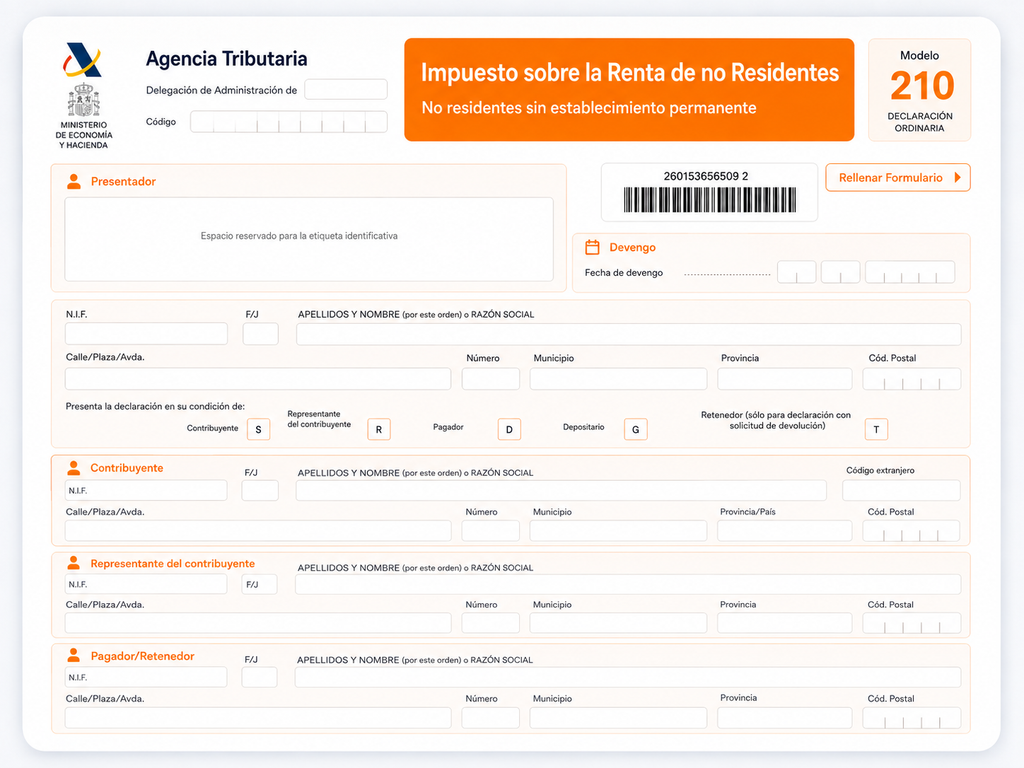
Modelo 210 is the Non-Resident Income Tax return (IRNR), the form used by people who are not tax resident in Spain but earn income connected to Spain. For property owners, it covers three different situations:
- Imputed income on a property you use yourself or leave empty (annual),
- Rental income if you let the property out (annual or periodic)
- Capital gains when you sell (filed shortly after completion).
This article focuses on the first two, the ones you deal with every year while you own. The tax on selling is covered separately in our guide to capital gains tax for non-residents selling a Spanish property.
The tax that surprises everyone: imputed income (renta imputada)
Here is the part that catches owners off guard. Even if your Spanish home sits empty for eleven months of the year and earns you nothing, Spanish law treats it as if it generated a notional rental income, and taxes you on that. This is called renta imputada, or imputed income.
The logic is that owning a second home that is available for your own use is a benefit, and Spain taxes that benefit. It applies to any urban property that is not your main residence and is not rented out for the period in question.
Paying your IBI does not cover this. IBI is a municipal tax billed by the town hall; imputed income tax is a national tax filed with the Agencia Tributaria on Modelo 210. They are two entirely separate obligations.
How is imputed income calculated?
The taxable base is a small percentage of your property’s cadastral value (valor catastral), which appears on your IBI bill:
- 1.1% of the cadastral value if that value was reviewed or updated within roughly the last ten years, or
- 2% of the cadastral value if it has not been updated recently.
That base is then taxed at the applicable non-resident rate:
- 19% for residents of the EU, Iceland, Norway or Liechtenstein, or
- 24% for residents of everywhere else.
Post-Brexit, UK owners are treated as non-EU and pay the 24% rate. This is one of the most significant practical changes for British owners since Brexit.
Worked example
Say a UK-resident couple owns a holiday apartment in Puerto de Mazarrón with a cadastral value of €90,000, last revised recently (so the 1.1% rate applies):
- Taxable base: €90,000 × 1.1% = €990
- Tax at 24% (non-EU): €990 × 24% = €237.60 per year
If there are two owners, each files their own Modelo 210 for their 50% share, so roughly €118.80 each. The figures are modest, but the penalties and interest for years of non-filing are not.
If you rent the property out
If you let your property, you must declare the actual rental income on Modelo 210 instead of (or as well as, for the periods it was empty) imputed income. The key difference by residence is significant:
- EU/EEA residents pay 19% on the net income, after deducting allowable expenses (a proportion of IBI, community fees, insurance, repairs, mortgage interest, etc.).
- Non-EU residents, including UK owners, pay 24% on the gross income with no deductions allowed.
That inability to deduct expenses makes the effective tax burden noticeably higher for British landlords than for EU ones. If you let to holidaymakers, remember you also need a valid tourist registration, as we explain in is it worth getting a tourist licence in Murcia.
Deadlines: when do I file Modelo 210?
Imputed income is filed annually, during the year following the tax year. For the 2025 tax year, the deadline is 31 December 2026.
Rental income filing windows are changing. Since 2024, rental income could be grouped into a single annual filing, and a 2026 reform (Order HAC/623/2026) further amends the deadlines and the information you must report, including a new annex requiring EU/EEA landlords to itemise deductible expenses category by category rather than as a single figure. Because these windows are in flux, confirm the current deadline for your situation before filing, our tax team tracks the changes.
Missing the deadline can lead to penalties, interest and surcharges. Late filings that you regularise voluntarily generally carry lighter surcharges than those the tax office chases you for, and you can usually back-file up to four years to catch up.
Why non-residents are getting caught out
The Spanish tax authority has significantly tightened enforcement in recent years, using automatic data cross-checks against the Land Registry and against digital rental platforms such as Airbnb and Booking. Owning a Spanish property is now easy for the authorities to see, which means non-filing is far more likely to be detected than it once was.
There is also a live legal question worth knowing about: the European Commission has formally challenged Spain’s rule that non-residents pay imputed income tax on properties they use themselves, on the basis that residents are not taxed the same way on their main home. As things stand you must continue to file, but if the rule is ever struck down, taxpayers who filed may be able to claim refunds for prior years, another reason to keep filing rather than ignore it.
What about IBI and other costs?
To keep the full picture clear, as a non-resident owner you typically face:
- IBI – annual municipal property tax, billed by the town hall.
- Imputed income tax (Modelo 210) – annual national tax, even if the property is empty.
- Rental income tax (Modelo 210) – if you let the property.
- Rubbish/refuse charges and community fees where applicable.
- Capital gains tax and plusvalía – only when you sell.
Our tax and accounting team handles Modelo 210 filings for owners across the Costa Cálida so nothing slips through the cracks.
Frequently asked questions
Do non-residents pay tax on a Spanish property they don’t rent out?
Yes. Even an empty second home is subject to imputed income tax (renta imputada), filed annually on Modelo 210. It is separate from your IBI council tax.
How much is non-resident imputed income tax in Spain?
The base is 1.1% or 2% of the cadastral value, taxed at 19% for EU/EEA residents or 24% for everyone else, including UK owners post-Brexit.
When is the Modelo 210 deadline?
For imputed income, you file during the year after the tax year, so 2025 income is due by 31 December 2026. Rental income deadlines are changing under a 2026 reform, so confirm the current window.
What happens if I never filed Modelo 210?
You can usually regularise the last four years. Voluntary late filing generally carries lighter surcharges than being chased by the tax office, which is increasingly likely given automatic data cross-checks.
Do both owners have to file separately?
Yes. If a property has more than one owner, each files their own Modelo 210 for their share of ownership.
Let us handle your Modelo 210
If you own a property in Murcia and are not certain your non-resident tax is up to date, or you have never filed imputed income tax at all, we can review your position, bring you up to date and file it for you each year.
Book a consultation or contact PALS in Puerto de Mazarrón and Alhama.

Antonio Legaz Morales
Antonio Legaz Morales is the founder and CEO of PALS Solicitors. A qualified Spanish lawyer, he is a registered member of the Ilustre Colegio de Abogados de Cartagena (Bar Association of Cartagena, Murcia), collegiate number 1106, and holds a law degree from the Universidad San Pablo-CEU in Madrid.
With more than 25 years in active legal practice, Antonio specialises in property conveyancing, Spanish tax, and inheritance and succession law for international clients on the Costa Cálida. He advises UK, Irish and other foreign nationals buying, selling and inheriting property across Puerto de Mazarrón, the Mar Menor and Condado de Alhama, guiding them through the Spanish legal and tax system in plain English.
View his professional profile on Legalia.